
Best Saudi Arabia to Pakistan cargo services by price 2026

Best overall approach: compare written door-to-door quotes with the same customs scope. Best for urgent cartons: express courier. Best budget candidate for non-urgent consolidated stock: sea freight. For your Saudi Arabia to Pakistan cargo price per kg search, Freightcorner offers international courier, air/sea freight and Delivered Duty Paid (DDP) shipping; request confirmation of your route, goods and duty coverage before booking.
- Compare Saudi Arabia to Pakistan cargo price per kg using chargeable weight and matching delivery scope.
- Freightcorner offers DDP shipping; confirm Saudi-route acceptance and exactly which duties and charges the quotation includes.
- Express courier suits urgent cartons; air freight suits time-sensitive cargo; sea freight deserves comparison for planned replenishment.
- Request written exclusions, customs responsibilities and delivery terms before choosing a cargo service in 2026.
Why the headline cargo rate is not enough
A shipment can attract collection, transport, clearance and destination charges under separate headings. Comparing only the freight component leaves you comparing different services, not different suppliers.
For recurring commercial shipments in 2026, ask every provider to quote the same goods, packaging and delivery address. The useful comparison is the total quoted shipment scope divided by the same weight basis—not the smallest advertised per-kilogram figure. Keep separately payable taxes visible rather than treating them as included.
The service options below are ranked by purchasing use case, not by an unsupported claim about the cheapest company. DDP describes contractual responsibility; courier, air freight and sea freight describe transport arrangements. You can request DDP terms alongside an appropriate transport option.
What makes the best Saudi-to-Pakistan cargo service
Judge each quotation against these criteria before comparing the totals:
- Chargeable weight: The provider identifies whether actual weight, volumetric weight or a minimum charge determines billing.
- Customs scope: The quotation names the party responsible for import clearance, duties, taxes and supporting documents.
- Delivery boundary: Collection, airport or port handling, and final delivery are explicitly included or excluded.
- Shipment suitability: The provider confirms acceptance of your commodity, packaging and commercial quantity.
- Exception handling: Storage, inspection, failed delivery and other contingent charges have written treatment.
- Repeatability: The same quotation format supports your next shipment without changing the comparison basis.
A seller replenishing stock needs a repeatable landed-cost calculation, not a one-off headline rate. Treat unclear exclusions as an unresolved quotation, not as evidence of a bargain.
Cargo options at a glance
| Rank and option | Best for | Standout feature | Key limitation |
|---|---|---|---|
| 1. DDP shipping enquiry | Sellers seeking defined duty responsibility | Combines transport planning with agreed import obligations | Requires confirmation of route, commodity and duty coverage |
| 2. Express courier | Urgent commercial cartons | Parcel-oriented collection and delivery workflow | Volumetric weight and commodity restrictions affect suitability |
| 3. Air freight | Time-sensitive consolidated cargo | Freight handling for commercial consignments | Airport handling, clearance and delivery need explicit scope |
| 4. LCL sea freight | Non-urgent stock below a full container | Shares container capacity with other shipments | Consolidation and destination handling complicate comparison |
| 5. FCL sea freight | Shipments suited to a dedicated container | Uses a full container rather than shared capacity | A per-kilogram comparison hides container-utilisation effects |
No rate table can replace a shipment-specific quotation. Use this ranking to select which options deserve a quote, then compare equivalent offers.
1. DDP enquiry: best for defined import-duty responsibility
Delivered Duty Paid is an Incoterm: a standard trade term allocating responsibilities between buyer and seller. Under DDP, the seller takes responsibility for import clearance and applicable import duties and taxes, with delivery at the named destination ready for unloading.
A logistics quotation labelled DDP still needs a defined place, accepted commodity and clear inclusions. Freightcorner's DDP shipping offering makes it a relevant quotation candidate for sellers seeking duty-paid arrangements; Saudi Arabia collection and Pakistan delivery must be confirmed for your consignment.
DDP enquiry pros:
- Establishes who arranges import clearance.
- Supports a defined duty-paid delivery scope.
- Helps sellers distinguish included charges from exclusions.
DDP enquiry cons:
- The label alone does not establish route or commodity acceptance.
- Incorrect classification or value information undermines the quotation.
Best for: Sellers who need written responsibility for destination duties before dispatch.
Verdict — Buy: Book only after the provider confirms the named destination, applicable import charges and exclusions in writing.
2. Express courier: best for urgent commercial cartons
Express courier suits shipments that fit a parcel-based handling network. Compare collection arrangements, commercial invoice requirements and delivery coverage alongside the transport charge.
Urgency does not remove customs obligations. Samples, replacement stock and saleable goods still need accurate descriptions and values; describe the transaction honestly rather than choosing a convenient label.
Express courier pros:
- Fits a carton-based dispatch workflow.
- Supports shipment-level tracking through the courier network.
- Lets you compare individual consignments without container planning.
Express courier cons:
- Bulky cartons can attract volumetric billing.
- Restricted commodities require acceptance checks before booking.
Best for: Small businesses sending urgent cartons that the selected courier accepts.
Verdict — Buy: Choose express courier when its quoted delivery service matches the commercial deadline and customs scope is clear.
3. Air freight: best for time-sensitive consolidated cargo
Air freight moves commercial cargo by aircraft, with handling and delivery arranged around the air movement. It deserves a separate quotation when your shipment no longer fits a straightforward parcel workflow.
Ask whether the offer is airport-to-airport, door-to-airport or door-to-door. Those boundaries change the work you must arrange in Pakistan and make apparently similar quotations materially different.
Air freight pros:
- Provides an alternative to parcel-based shipping.
- Allows separate planning for collection, clearance and delivery.
- Supports comparison for consolidated commercial consignments.
Air freight cons:
- Terminal handling can sit outside the quoted freight component.
- Missing destination arrangements leave work for the consignee.
Best for: Sellers moving time-sensitive stock with a clear commercial invoice and packing list.
Verdict — Buy: Select air freight after all origin and destination handling responsibilities are assigned.
4. LCL sea freight: best for planned shared-container shipments
Less than Container Load (LCL) combines shipments from different customers within a container. Compare it when your replenishment can follow a planned sea-freight schedule without requiring a dedicated container.
Do not force an LCL quotation into a weight-only comparison. Sea-freight billing can depend on shipment volume, weight and minimum charges, while consolidation and destination handling require separate attention.
LCL sea freight pros:
- Provides access to shared container capacity.
- Fits replenishment planned around a sea-freight movement.
- Allows comparison without committing to a full container.
LCL sea freight cons:
- Consolidation adds handling stages.
- Destination charges can distort a freight-only comparison.
Best for: Businesses with non-urgent replenishment that does not require exclusive container use.
Verdict — Hold: Obtain the complete destination-charge schedule before treating LCL as your budget choice.
5. FCL sea freight: best for dedicated-container planning
Full Container Load (FCL) means booking a full container rather than sharing its capacity through LCL consolidation. Assess the container requirement from your packed cargo, loading method and receiving arrangements.
FCL is not automatically the right choice because an order is heavy. Compare container utilisation, port handling and inland delivery against other suitable transport arrangements.
FCL sea freight pros:
- Provides dedicated container capacity for the shipment.
- Avoids sharing booked capacity through LCL consolidation.
- Supports a container-level loading and delivery plan.
FCL sea freight cons:
- Unused capacity weakens the shipment-level comparison.
- Container handling and receiving access need advance planning.
Best for: Importers whose shipment and receiving operation justify a dedicated container.
Verdict — Buy: Choose FCL only after confirming cargo fit, container requirements and destination delivery arrangements.
How these options are ranked
The 2026 ranking prioritises defined customs responsibility, shipment fit and complete delivery scope. DDP enquiries come first because duty responsibility must be settled before you compare transport offers; the remaining options separate urgent cartons, air cargo and containerised replenishment.
This is a purchasing framework, not a carrier-performance league table. A lower freight line does not win if its quotation excludes work that another offer includes.
Prepare dimensions before requesting a per-kilogram quote
Use your final packed shipment, not the unpacked product specification. Measure every carton and retain the units beside each measurement so the provider can calculate chargeable weight correctly.
For an illustrative carton weighing 8 kg and measuring 40 cm long, 30 cm wide and 25 cm high, submit all four measurements. These are example shipment details, not a carrier allowance or a billed-weight calculation. Ask for the provider's actual volumetric formula and rounding rules rather than applying an assumed divisor.
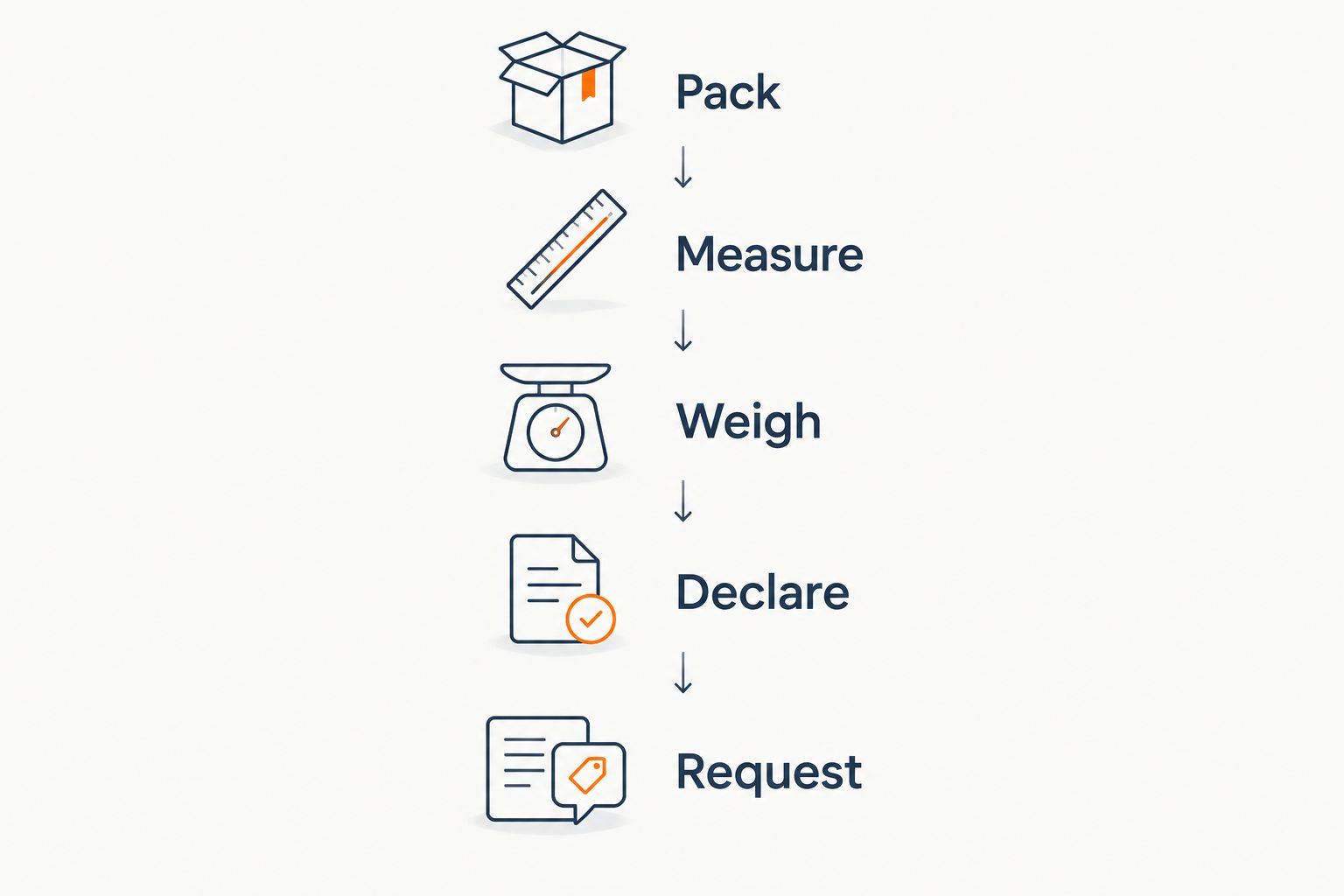
- Pack: Finish protective packaging before measuring.
- Measure: Record each carton's external dimensions.
- Weigh: Record gross weight, including packaging.
- Declare: Match contents and quantities to the invoice.
- Request: Submit one consistent specification to each provider.
Keep a separate row for each carton when sizes differ. Combining unlike packages into an average dimension can misrepresent the shipment presented for collection.
Check customs responsibility before accepting a quote
For Saudi Arabia-to-Pakistan commercial cargo in 2026, establish who exports, who imports and who supplies the required documentation. The transport booking and the sale contract should not assign conflicting responsibilities.
Your cross-border shipping questions should establish who validates commodity descriptions, supplies importer details and handles a customs query before collection. A duty-paid label does not replace that division of work.
Ask the provider to confirm:
- Commodity classification: The proposed Harmonized System (HS) classification and the information needed to support it.
- Declared value: The commercial value and supporting transaction documents.
- Importer details: The receiving business and the party responsible for import formalities.
- Product controls: Any permits, certificates or special acceptance requirements identified for the goods.
- Customs queries: Who answers requests for clarification and how additional charges require approval.
Freightcorner offers customs-clearance coordination, but coordination does not remove your responsibility to provide accurate shipment information. Keep product descriptions specific: material, function and commercial quantity are more useful than a broad label such as accessories.
Request a comparable shipping quotation
Complete shipping quote requests with enough detail to establish scope. A message asking only for a kilogram rate leaves the provider without the information needed to assess your shipment.
Send this checklist:
- Saudi collection city and full collection address.
- Pakistan destination city, postcode and delivery address.
- Product descriptions, intended use and commercial quantities.
- Carton count, individual dimensions and gross weights.
- Invoice value and currency.
- Requested collection date and required arrival window.
- Preferred courier, air or sea option, if known.
- Whether you require a DDP proposal or separately stated import charges.
- Any batteries, liquids, food, cosmetics or other goods needing acceptance checks.
For Pakistan-to-UK and Pakistan-to-USA shipments, use the same quotation discipline but request a fresh destination-specific customs scope. Do not carry assumptions from a Pakistan import quotation into an export booking.
Ask Freightcorner to return a written quotation with inclusions, exclusions, validity and estimated service timing. Do not book against an unconfirmed delivery date or assume that every quotation includes duties.
Request your shipment quote
Send the route, goods, carton dimensions, weights and duty requirements for a shipment-specific quotation.
Which cargo option should you choose?
For your 2026 shipment, start with the delivery obligation, then select the transport mode. Request DDP terms when you need seller-arranged duty-paid delivery; compare courier for urgent cartons, air freight for time-sensitive cargo and sea freight for planned replenishment.
Freightcorner is a quotation candidate for commercial shippers seeking DDP shipping and customs-clearance coordination. Confirm the Saudi-to-Pakistan route and your goods before treating any service as bookable.
FAQ
What's the best Saudi Arabia to Pakistan cargo price per kg?
The best comparison uses shipment-specific quotations with the same chargeable weight, delivery boundary and customs scope. Request a complete quotation rather than choosing an isolated freight rate.
Is sea freight better than air freight for commercial stock?
Sea freight suits planned replenishment, while air freight suits time-sensitive cargo. Compare complete shipment quotations, including handling, clearance and final delivery, before choosing.
Does DDP mean Pakistan import duties are included?
DDP assigns import clearance and applicable import duties and taxes to the seller. Confirm the named destination and written coverage in the sale terms and logistics quotation; not every shipping quote is DDP.
Why does a cargo company ask for carton dimensions?
Carton dimensions help establish volumetric weight or shipment volume. The billed basis depends on the selected service, its calculation rules and any minimum charges.
Can Freightcorner quote Saudi Arabia-to-Pakistan commercial cargo?
Request route and commodity confirmation from Freightcorner before booking. Submit collection and delivery addresses, goods descriptions, invoice value, carton dimensions, gross weights and duty requirements.
What paperwork should I prepare for a commercial shipment?
Prepare a commercial invoice and packing list, then confirm shipment-specific requirements with the provider. Classification, product controls and importer details determine what additional documents are required.
Can I use the same quotation for regular repeat shipments?
Use the same quotation template, but obtain confirmation for each booking. Shipment dimensions, contents, customs requirements and quotation validity must still match the cargo being dispatched.
One last thing
Keep the accepted quotation beside the final invoice, not just in a messaging thread. Reconcile each additional charge against the agreed scope before you dispatch the next shipment; that turns a one-off booking into a repeatable purchasing process.